


The Hidden Costs of Informal Risk Management for Hedge Funds and Trading Firms
It's often said that 90% of traders fail. Only 10% consistently win. This makes many new traders ask: what separates the winners from the rest? The answer is often simple: risk management.
Financial markets today are fast, leveraged, and highly connected. Global derivatives exposure exceeds $600 trillion, according to BIS data. Volatility in equities, crypto, and FX has also risen sharply over the last decade. In this environment, risk is no longer a back-office task. It affects every decision and every trade.
Yet many firms still rely on informal risk management. Decisions are often based on intuition, experience, or ad hoc rules. These may work in the short term. But over time, the cost becomes clear.
The real danger is not sudden collapse. It is slow, compounding losses. Capital erodes. Growth stalls. Risk quietly builds.
In modern markets, ignoring risk management is not an option. Firms that formalize it are more resilient. They survive volatility. They scale safely. They increase their chances of being in the 10% who consistently win.
Why Informal Risk Management Persists?
Informal risk management is common, especially in founder-led or fast-growing firms. A 2025 FCA survey of 270 UK corporate finance firms found that 11% had no documented business-wide risk assessment, as required under Money Laundering Regulations (FCA, 2025). This shows that informal practices are still widespread.
One reason is early success bias. Many firms are started by traders whose intuition delivers strong early returns. When P&L looks good, risk often feels "under control," even if it is undocumented.
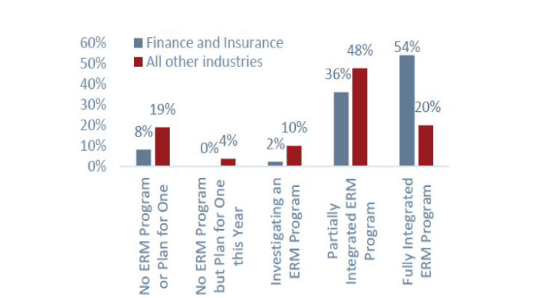
Operational complexity adds to the problem. McKinsey notes that during scaling, firms face analytics deployment delays of up to 18 months due to friction in validation, deployment, and monitoring. Banks and trading firms also face rising nonfinancial risks like cybersecurity (73% priority) and financial crime (45%), which grow as firms expand and adopt new technologies.
Speed is another factor. In competitive markets, execution and latency matter. Formal risk controls can feel slow. Approvals take longer, oversight increases, and traders feel restricted. As a result, risk decisions often live in spreadsheets, Slack messages, or a founder's head rather than in structured systems.
Finally, informal risk often feels cheaper. Hiring risk professionals and building frameworks costs money. Firms underestimate the hidden cost of not having proper risk management.
Best Practices from Leading Financial Institutions to Reduce Operational Risk
Leading banks mitigate financial institution risk by linking operational risk to business impact, upgrading governance, building operational-resilience capabilities, and investing in data, analytics, and tooling.
They embed pre-trade risk controls, continuous position monitoring, and integrated dashboards to spot systemic risk blind spots in real time. Firms adopting these frameworks move from reactive risk control to proactive risk management, reducing unexpected losses and improving financial risk governance.
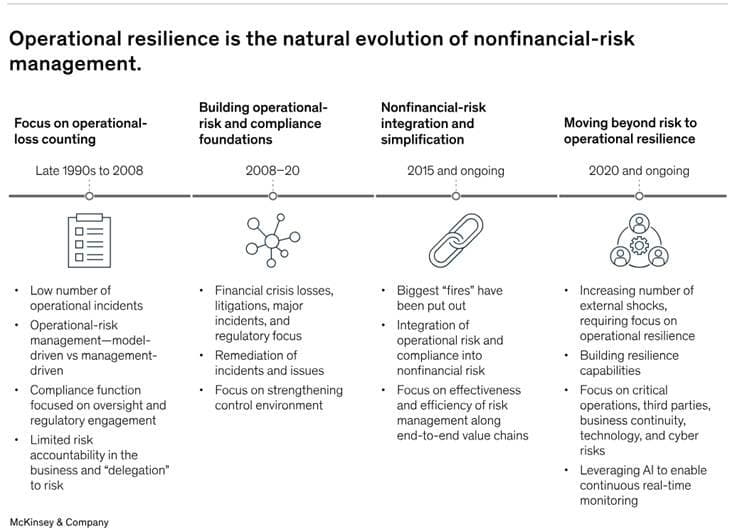
Managing risk has changed a lot since the 1990s. Back then, firms mostly focused on operational losses. Today, banks build strong operational-risk and compliance frameworks. They focus on operational resilience in governance, processes, and decision-making.
Here are four key practices:
1. Link risk to business impact
Top institutions connect risk reporting to real business decisions, like outsourcing, growth, or acquisitions. They integrate risk into day-to-day reporting and ensure risk professionals understand both risk concepts and business operations.
2. Upgrade governance
Banks set up board- and executive-level committees for nonfinancial risk. They assign risk stewards to monitor key metrics, such as delayed issue resolution or failed compliance checks. This ensures risks are tracked and addressed consistently.
3. Build operational-resilience capabilities
Banks focus on business continuity, scenario planning, technology recovery, third-party risk, and incident response. Over 90% of banks have identified their critical business services, and ~65% have plans to maintain them. They test multiple scenarios, monitor hundreds of third parties, and prepare for both internal and external disruptions.
4. Invest in data, analytics, and tooling
Institutions use AI, machine learning, and integrated data platforms to monitor risks continuously. Dashboards combine leading and lagging indicators for real-time oversight, helping teams respond quickly, like a mission-control center.
How Banger FinLabs Helps Firms Adopt Structured Risk Management
While leading banks manage risks through robust frameworks and technology, Banger FinLabs helps smaller trading firms and fintechs apply the same principles, turning intuition into structured, scalable risk management.
Banger FinLabs works with trading firms, fintechs, and exchanges that recognize this inflection point: intuition alone no longer scales.
Rather than replacing trader judgment, Banger FinLabs focuses on institutionalizing it. The firm helps translate trader experience and founder insight into structured, repeatable risk frameworks aligned with real trading behavior.
According to industry benchmarks, firms that implement formal risk governance see improvement in risk-adjusted returns over multi-year periods, not by reducing risk, but by managing it consistently.
Banger FinLabs also supports infrastructure-aligned risk design, ensuring that risk controls are not theoretical but embedded into trading systems, reporting workflows, and operational processes.
Reach out to our team here and discover how Banger FinLabs can help your firm manage risk with confidence.
Formal Risk Is a Growth Strategy, Not a Constraint
Informal risk management often feels efficient, until it isn't. In modern financial markets, unmanaged risk does not simply increase downside; it limits upside.
The firms that endure are not those with the boldest bets, but those with the discipline to survive volatility, scrutiny, and scale. Formal risk management is no longer a regulatory checkbox—it is a strategic advantage.
For trading firms aiming to grow with confidence, the question is no longer whether to formalize risk, but how soon.
FAQs: The Hidden Cost of Informal Risk Management
1. How do hedge funds manage operational risk?
Hedge funds rely on formal risk management frameworks to monitor exposures, enforce limits, and reduce operational losses. Firms that skip structured risk controls often face hidden costs and compliance gaps.
2. What are the consequences of poor risk management?
Poor risk management can lead to capital leakage, operational fragility, compliance penalties, and reputational damage. Informal practices also increase the opportunity cost of growth and limit investor confidence.
3. Can fintechs scale without a risk framework?
Scaling without a risk framework is risky. Firms may rely on trader intuition or ad hoc rules, creating risk oversight failures. Structured risk practices, like those implemented by Banger FinLabs, improve operational resilience and reduce unexpected losses.